AI-Powered Invoice Automation
AutoProdut
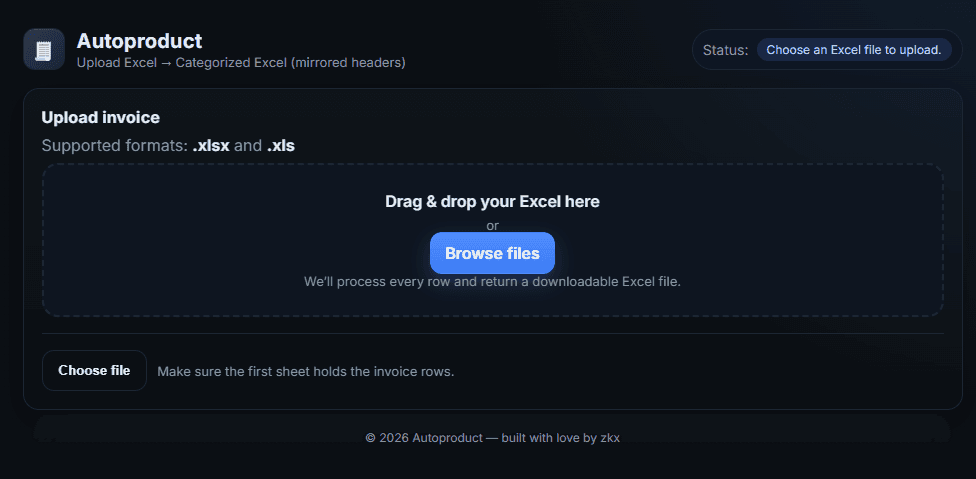
Autoproduct is an AI-powered invoice processing tool built for a retail business that receives supplier invoices in dozens of different formats — different layouts, column names, file types, and product naming conventions. Their existing POS system only accepts one standardized format, which meant someone had to manually re-key and re-categorize every product from every invoice before it could enter the system. Autoproduct eliminates that bottleneck entirely. Upload any supplier invoice, and the tool uses AI to extract product data, auto-categorize items according to the shop's own category structure, and output a clean, POS-ready format that can be applied directly — no manual entry, no guesswork.
Client
Australian Retail Business
link
Industry
Retail & Supply Chain Automation
Scope of work
Full-Stack Development
Data Analytics
AI Integration
Problem
Retail businesses work with multiple suppliers — each one sends invoices in their own format. One supplier uses Excel with product codes in column B. Another sends a PDF with descriptions spanning two lines. A third emails a CSV where "Coca Cola 375ml x 24" is a single string with no separated fields for brand, size, or quantity. The shop's POS system needs every product in a specific, uniform structure — standardized category, product name, quantity, unit price, and supplier reference — before it can be entered into inventory. Without automation, a staff member spends hours each week manually reading invoices, identifying products, looking up the correct POS category, reformatting the data, and entering it line by line. It's slow, error-prone, and completely unscalable as the business grows and supplier count increases.



Challange
The core challenge was building an AI pipeline that could reliably parse unstructured, inconsistent invoice data and map it to a rigid, shop-specific category system — every time, regardless of supplier format. Invoices arrive as PDFs, Excel files, and CSVs, each with different column headers (or no headers at all), inconsistent product naming, and varying levels of detail. A product listed as "CC 375 CAN x24" on one invoice and "Coca-Cola Classic 375ml Carton (24 Pack)" on another needs to resolve to the same POS entry. The AI had to learn the shop's own product taxonomy — not a generic grocery classification — and assign categories that match exactly what the POS system expects. Edge cases are constant: bundled items, promotional packs, misspellings, abbreviated supplier codes, and mixed-unit pricing. On top of all that, the tool had to be fast and simple enough for non-technical retail staff to use daily without training.

Solution
Autoproduct was built as a web application that takes any supplier invoice and transforms it into a clean, POS-compatible product list — powered by AI at every step of the pipeline. Key technical decisions: → Multi-format document parsing — the system accepts PDFs, Excel (.xlsx/.xls), and CSV files. PDFs are processed using text extraction with layout analysis to preserve table structure. Excel and CSV files are parsed with column detection logic that adapts to different header naming conventions. The parser identifies product rows, quantities, unit prices, and totals regardless of where they appear in the document. → AI-powered product recognition and categorization — extracted product data is sent through an AI classification layer that maps each line item to the shop's specific category taxonomy. The model understands product variants, abbreviations, and bundling patterns. "CC 375 CAN x24" and "Coca-Cola Classic 375ml Carton" both resolve to the same category and product entry. The system learns from corrections over time, improving accuracy as the shop processes more invoices. → Shop-specific category mapping — the category structure is fully customized to the client's POS system. This isn't generic retail classification — it mirrors the exact hierarchy the POS expects, down to sub-categories and naming conventions. New suppliers or unusual products are flagged for manual review rather than silently miscategorized. → Human-in-the-loop review interface — after AI processing, the user sees a clean table of categorized products with confidence scores. High-confidence items are pre-approved. Low-confidence or unrecognized items are highlighted for quick manual correction. The interface is designed for speed — retail staff can review and approve an entire invoice in under two minutes. → POS-ready export — once approved, the system outputs the product list in the exact format the POS system accepts. No reformatting, no copy-pasting, no manual field mapping. The output can be imported directly, updating inventory with accurate categories, quantities, and pricing from the supplier invoice. → Supplier pattern learning — as the shop processes more invoices from the same supplier, the system builds a supplier profile that improves parsing accuracy. Column positions, product naming patterns, and pricing structures are remembered, making subsequent invoices from that supplier faster and more reliable. The result is a tool that turns a multi-hour weekly task into a two-minute review process — eliminating manual data entry errors, accelerating inventory updates, and scaling effortlessly as the business adds new suppliers.